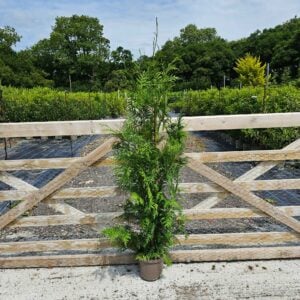
Western Red Cedar, is a conifer that looks similar to Green Leylandii and grows almost as fast. It has dark, olive-green leaves that can turn bronze in winter. The foliage has a pleasant, fruity fragrance when the leaves are crushed. It can be cut back into old wood and will re-shoot.
Thuja plicata, also known as Western Red Cedar, is a conifer that looks similar to Green Leylandii and grows almost as fast. It has dark, olive-green leaves that can turn bronze in winter. The foliage has a pleasant, fruity fragrance when the leaves are crushed. Thuja plicata can be cut back into old wood and will re-shoot.
Planting Advice
Thuja | Western Red Cedar
How tall will Thuja plicata grow?
You can keep a Thuja hedge at any height and as narrow as 45cm (18in). It withstands clipping very well. Remember, if you keep a hedge at 2-3m (6-8ft) tall (or lower), it is much easier to trim than if you let it grow taller. If left untrimmed, Western Red Cedar will grow up to 20-35 metres tall (70-120ft) and makes a fabulous specimen tree – but you obviously need a lot of space for this. Specimen trees can be seen in the gardens of many stately homes such as Stourhead and Bicton Park..
How often would I need to trim a Thuja plicata hedge?
Trim your hedge once or twice a year. Late spring/early summer is the best time to trim the hedge. If you think it needs another trim, then trim again in late summer/early autumn but don’t leave it too late before the winter – allow some time for re-growth before the winter cold.
Why plant Thuja plicata (Western Red Cedar)?
Fast growing
Evergreen
Good for screening and all year round privacy
Acts as a windbreak
Hardy
Will re-shoot from old wood
Scented foliage
Grows in any soil (apart from water-logged)
Grows in sunny or shady areas
What type of soil does a Thuja plicata hedge need?
Thuja will grow in any free-draining soil (i.e. any soil that is not water-logged). It will even grow on shallow chalk soils.
How far apart should I plant Thuja plicata?
You should plant between 60 and 100cm (2-3ft) apart. If you want the gaps between the plants to fill in quickly to form a hedge, then plant at 60cm (2ft) apart. If you are happy to wait a bit longer, then plant at 1m (3ft) apart because you will get just as good a hedge, it will just take about a year or so longer for the plants to join together to form a hedge.
There are a number of different varieties of Thuja plicata. We now exclusively grow Thuja plicata ‘Excelsa’. This is because, after over 50 years of growing Thuja plicata, we find its healthy, dark-green foliage and habit of growth make by far the best hedge.
Varieties (or Cultivars) such as Thuja plicata ‘Atrovirens’ and ‘Gelderland’ are not as healthy as ‘Excelsa’ and can suffer from Thuja Blight. Thuja plicata ‘Martin’ is a healthy variety but has a much more upright habit of growth.
All varieties of Thuja plicata (including ‘Atrovirens’) are fast growing and will turn bronze in cold winters, especially if exposed to cold winds. This is their natural method of coping with the conditions and the hedging plants will green up again in the spring. If you prefer a hedge to stay green all year round, consider Leylandii instead.
There is also a variegated variety, called Thuja plicata ‘Zebrina’ which is slower growing but still forms a good hedge. Please give us a call if you are interested in this variety.
All varieties of Thuja plicata with green foliage are the best as fast-growing hedging plants along with Thuja occidentalis ‘Brabant’ which grows at a similar rate.
Alternatives to Western Red Cedar
Green Leylandii is similar to Western Red Cedar and grows slightly faster, as a result, it is usually cheaper.
Thuja occidentalis ‘Brabant’ is very similar to Thuja plicata. It has a similar rate of growth and forms a dense evergreen hedge.
Laurel (Prunus laurocerasus) is a quick-growing, evergreen shrub – so if you don’t want a conifer, Laurel is the fastest growing evergreen hedging plant.
Thuja occidentalis ‘Emerald’ is a slower growing conifer that needs very little maintenance. It does not need clipping on the sides as it never grows very wide, however, you can prune the tops once a year to keep the hedge to the height you want.